Resident Evil: Fire and Ice
Resident Evil: Fire and Ice came up as part of the conversation in this episode.
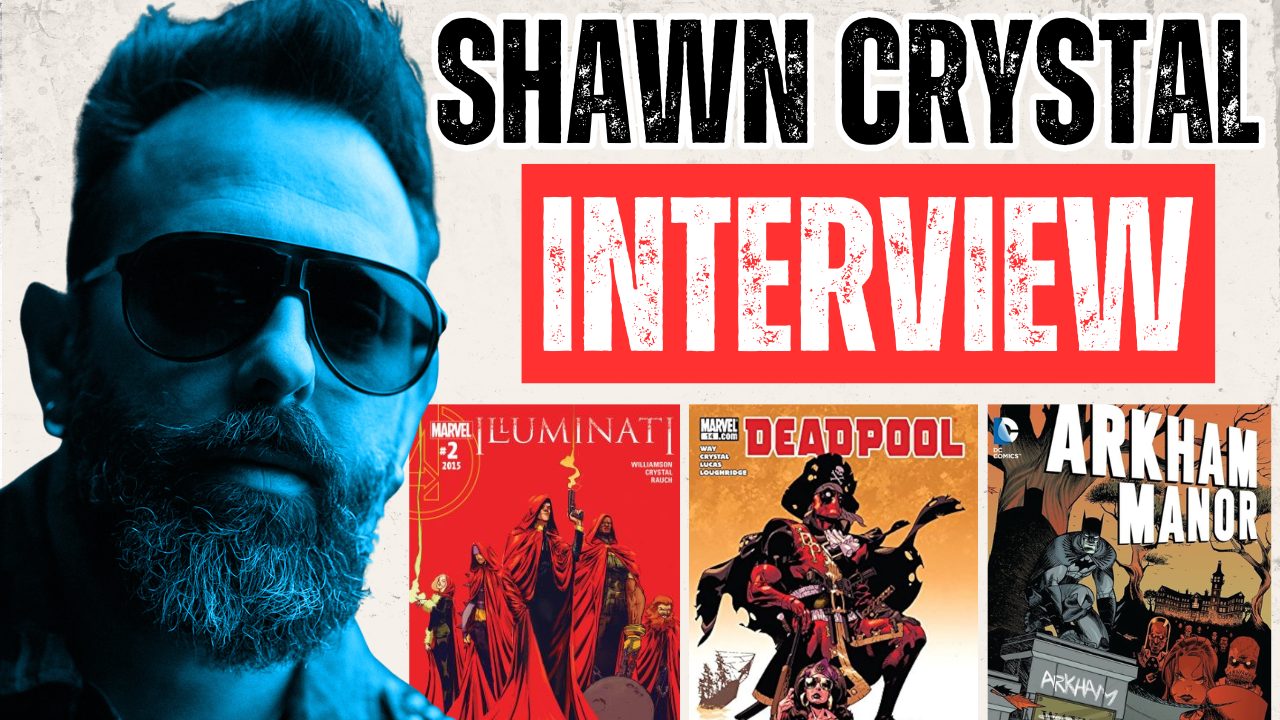
Shawn Crystal joins Splash Pages for a career-spanning conversation that starts with WildStorm and Resident Evil, runs through five years on Deadpool and Deadpool MAX, and hits Arkham Manor, Scarlet Witch, Illuminati, tattooing, teaching, and the creator-first model behind Inkpulp. It is one of the clearest episodes in the archive about how networking, style, and long-term craft growth actually work in a comics career.
Don't go to art school. It's too expensive, and you're going to get saddled with a debt that is going to haunt you for the rest of your life.
Shawn Crystal on Splash Pages Comic Book Club
Resident Evil: Fire and Ice came up as part of the conversation in this episode.
Deadpool MAX came up as part of the conversation in this episode.
Arkham Manor came up as part of the conversation in this episode.
Scarlet Witch #14 came up as part of the conversation in this episode.
Illuminati: Life of Crime came up as part of the conversation in this episode.
He broke in through Resident Evil: Fire and Ice at WildStorm after Lee Bermejo and John Layman both independently handed the same sample packet to an editor who needed a replacement artist.
Crystal says the opportunity came through a long friendship with Axel Alonso. He made a point of never treating Axel like a work contact, and eventually Axel called him directly with Deadpool.
Crystal describes Deadpool MAX with David Lapham as one of his most creatively fulfilling projects because the MAX line gave them room to push the character in stranger, darker directions.
Gerry Duggan pitched it as his episode of Batman: The Animated Series, which immediately gave Crystal a tone and visual logic he could latch onto.
It is part press, part teaching platform, part artist community, and part launch engine for projects like The Fourth Father, letting him build outside the usual art-school and publisher pipeline.
Cleaned transcript below. Editorial section headings and quote callouts have been added for readability.
Opening cold open / commercial condensed: The episode opens with a zombie sketch and Deadly Grounds sponsor bit before the live conversation starts.
Leo [00:03:39]: Hey. Hey. Happy Tuesday, everybody. You are watching Splash Pages. My name is Leo. I’m the monkey behind the keyboard here. Have an amazing show scheduled for you, as always, and we’ll kick it on over to Jar Jar. How’s it going, bud?
Jar Jar [00:03:51]: It’s going good, man. It’s Tuesday. We’ve got another great guest on. And how about we see what Drew is up to?
Drew [00:04:00]: Yes. What am I up to? I don’t know, but it’s Tuesday. So the show does go on. Sorry, everybody — was pondering some wisdom from our guest. He’s quite astute. If you’ve read Marvel and DC, you probably most definitely have seen his work. He did five years of Deadpool-related content. He started off with a Resident Evil project. He’s done a lot of stuff over at Marvel and DC. Right now he’s killing it as an instructor, but he’s still drawing. He’s a tattoo artist as well. So if you’re looking for some sweet ink, I would talk to Shawn Crystal here. The one. The only. Shawn. Crystal.
Shawn Crystal [00:04:52]: What’s up?
Drew [00:04:52]: What’s up, man? Welcome. Thank you for joining us. We appreciate it. It’s good to see you — I think again. Last time I saw you, we were doing selfies at New York.
Shawn Crystal [00:05:05]: Yeah. I remember.
Drew [00:05:21]: It’s funny because, you know, you think Comic Con, you’re thinking all the things, and somehow just fashion choices are what stand out.
Shawn Crystal [00:05:29]: Yeah. A nice bright color will make people remember pretty much anything.
Drew [00:05:34]: But speaking of bright colors — I was looking through your background. I did not know it started with you trying to break into music illustration.
Shawn Crystal [00:06:04]: Well, I was an illustrator trying to break into the music scene with illustration. I wanted to do comics, but some opportunities just came my way that I decided to explore. That led to other opportunities and I kind of went down that wormhole a little bit doing some music illustration. But I just hit a point where I was like, this isn’t what I want to be doing. I want to be doing comics.
Drew [00:06:34]: And your first project came because of people you met at a con, including Lee Bermejo — one of Leo’s heroes.
Shawn Crystal [00:07:01]: Yeah. Lee Bermejo had a giant role in my first job in comics. I was in grad school studying comics and I was going to a lot of conventions, networking hard. I was meeting everyone, and everyone knew I was trying to break in. I went to MegaCon in Orlando and I had some sample pages. At the time I was really focused on a — I don’t want to say realistic, but a more classic style. Kevin Nowlan was my big hero. He still is. But my work was very in line with Kevin Nowlan. So I had some sample pages of a short story I’d done in school. Back then, before the internet, we had to make xeroxes of our pages and put our contact info on each page and leave those with people. And so I met Lee Bermejo. I always like going up to artists to talk to them — to talk craft, learn, hear how they did things. So I showed Lee my work and he liked it. And obviously we shared a similar aesthetic, so we connected on that level. At the same con, John Layman was an editor at WildStorm at the time, while Lee was at WildStorm. And so I went to the WildStorm booth and John Layman looked at my portfolio and liked the work. He took a packet, and Lee took a packet. Lee at the time was on a book called Resident Evil: Fire and Ice. He had finished the first half of issue one, I believe, and then was offered Superman/Gen 13. So the smart move is to go to Superman/Gen 13, which left his editor at WildStorm needing an artist that could come in after Lee without too much of a style jump. When they got back from MegaCon, Jeff Mariotte [VERIFY], who’s the editor, was like, “I don’t know who to replace Lee with.” And Lee was like, “Oh, I got a guy.” And he gave him my sample packet. And then later that day, John Layman came in his office — “I gotta find someone to replace Lee.” And John was like, “I got a guy.” And he gave him the same packet. Same stuff. So Jeff Mariotte called me and was like, “Hey, I have a project, and apparently you’re somebody I need to know.” And I tried to talk my way out of it — I was in school, I was very overwhelmed. I was like, “How am I going to do this?” And he was like, “No, no, no — you’re my guy. I’ve been looking for a long time, and Capcom is rejecting everyone. They like what they’re seeing of your work, so I need you. You got this. This is it.”
Shawn Crystal [00:10:05]: And I was like, okay, yeah, I’m going to do it. I did a sample — there were a few artists up for it. Me, John Lucas, and I remember it might have just been us two; maybe one more. We all did a sample image for Capcom and they chose mine. So I got it.
Jar Jar [00:10:42]: Did you have a lot of interaction with the suits from Capcom? Did they tell you what you could or couldn’t do?
Shawn Crystal [00:10:52]: No — they were really hands off from my end. I’m sure on the editorial side things were being handled, but artistically, none of the characters we were drawing were from the game. They were created specifically for the comic book to expand the Resident Evil universe. So there was no likenesses issue. But WildStorm had some restrictions — it couldn’t be an X-rated, violent blood-fest comic. I could only get away with a certain amount of gore. I remember early on being like, “This is a zombie book — like, I can’t draw blood? How are we gonna do this?” But honestly it was so hands off. And I think at the time I got it, it was so off schedule because Lee puts a lot of time into his pages and had been falling behind. Then he left, and they were having so much trouble finding someone to replace him.
Leo [00:13:08]: Just to piggyback — you mentioned it’s a zombie game with blood and guts, and they told you to tone it down. It reminds me of when the game first came out — I used to sell video games, and the American version was apparently a dulled-down version of the Japanese release.
Shawn Crystal [00:13:27]: Oh, really? I didn’t know that. Well, that was a WildStorm thing — not Capcom. WildStorm said, “We want to reach as many people as we can with this book.” And it wasn’t a Vertigo title — the DC merger actually happened while I was working on it. I went from getting paid by WildStorm to getting paid by DC. And honestly, I think part of toning it down was that they wanted to look more attractive to DC for the merger.
Leo [00:14:07]: That’s smart.
Drew [00:14:09]: And then after that — ten years went by before your next gig?
Shawn Crystal [00:14:15]: Yeah. Ten years went by before my next gig, and that was by no choice of mine. I was still going to every convention, still making sample pages, still networking. I knew just about everyone in the business — every editor, I knew what they worked on. I’d made good friends who were just monster talents. Darwyn Cooke — I became good, good friends with him, man. But a few things had happened. As I was working on Resident Evil, I had started out very naturalistic — not realistic, but naturalistic. Like real people and real proportions. But before that, before grad school, I was super cartoony — like Humberto Ramos, Joe Madureira, J. Scott Campbell. Those guys were really speaking to me. So I went to grad school and decided to completely erase my style and just start training like a Renaissance artist. Just referencing everything, trying to draw what I see, developing my skills of observation. Through Resident Evil, because now I’m on a deadline, that cartooniness started creeping back in — but in a much more informed place. By the time I drew the very last page of Resident Evil, I was like, “Oh man — that’s me.” I felt like I found myself. It was very much like Jason Pearson; Jason was my hero art-wise at that time. And I remember coming off that book around the time Quesada put down a mandate at Marvel: no cartoony artists.
Jar Jar [00:16:20]: Oh, really?
Shawn Crystal [00:16:21]: Yeah. This was around the time the Ultimates was being developed. He wanted everything to look like it belonged in a movie. Which sucked for me, because I don’t like very photorealistic-looking comics. They look too much like the world I know. I like a Mignola book where I can open a page and I’m in a world I’ve never seen before. So I went from editor to editor at Marvel — “I like what you’re doing; I can’t hire you. You’re just too cartoony.” Same at DC: “I like what you’re doing, but you’re a bit eclectic. If you just tweak your style, I can get you on something.” And I didn’t want to do that. I was like, I’m not in this for that.
Drew [00:17:35]: And then one day, Axel Alonso was like, “Hey, I think you’d be really good for this. It’s Deadpool.”
Shawn Crystal [00:17:46]: Yeah. Axel and I had become very close friends through all the networking I’d done. I got to know everyone. And I just got to a point where it was like, I don’t want to be the guy everyone sees coming — “Oh no, Shawn’s coming, asking for work.” So when I met Axel, I was like, I’m not even going to ask him. I never asked Axel for work. Ever. We just had a shared love of hip hop music. Whenever I saw Axel, it was like, “Hey, let’s go grab lunch, let’s talk about music.” And that’s all we did. We became very good friends, and I was like, “You know what? He’s a really good friend now. I’m not gonna put that pressure on the table.” And one day he calls: “Hey, I think I have something for you.” I was like, I’m not asking. He was like, “I know, but I like what you’re doing. I just had to find the right fit for you.” And this was when Daniel Way’s Deadpool — issue one and two, maybe three — had come out. Big hits. So they were like, let’s get an annual going. He knew I was teaching full time — he’d visited me at SCAD and given lectures. He was like, “With your teaching schedule, an annual is gonna be perfect for you. The deadline won’t be as tight. Cut your teeth here and we’ll go from there.” So I did the annual, and then it was just Deadpool, Deadpool, Deadpool, Deadpool for five years.
Drew [00:19:12]: And my first introduction to you was the pirate arc — Deadpool deciding he’s going to be a pirate, with Bob, Agent of Hydra in a parrot suit. And speaking of greatness — Jason Pearson did that phenomenal Deadpool-as-Blackbeard cover.
Shawn Crystal [00:19:39]: Yeah.
Drew [00:20:03]: The alternating artists — was that Angel Medina and Carlo Barberi?
Shawn Crystal [00:20:06]: Is that Bong Dazo?
Drew [00:20:08]: Bong was one of the later artists. Angel Medina and Carlo Barberi — they were alternating in the first arc. And you fit in great because your style was a little cartoony, a little grittier.
Shawn Crystal [00:20:28]: Yeah.
Drew [00:20:29]: And then the humor — I’d never bought a Deadpool comic and I was just like, “Boy, this humor is something.”
Shawn Crystal [00:20:39]: Yeah. That’s what spoke to people — it was fun, it made people laugh. Axel’s whole pitch to Daniel Way was like, “I want to do Looney Tunes in the Marvel universe.” That was the hot take on it.
Jar Jar [00:20:55]: That must have been an interesting script to receive.
Shawn Crystal [00:20:59]: Yeah. Daniel’s scripts were good. When I got to work with David Lapham on the MAX series — that’s when it got really interesting. That was MAX, so you could use whatever you wanted. We did some wild stuff, man.
Drew [00:21:36]: I remember reading — you mentioned a quote that Brian Stelfreeze said to you: “The script is made of clay, but the dialogue is made of stone.”
Shawn Crystal [00:21:39]: Yeah. Research.
Drew [00:21:58]: You worked with James Robinson on Scarlet Witch. You’ve talked about how much you loved working with him — especially the extra attention to detail in his scripts.
Shawn Crystal [00:22:28]: Yeah. James gave me one of my favorite scripts I’ve ever worked from. Working with David was school — Stray Bullets was my favorite comic, and his scripts were made by an artist who understood. Dave writes his scripts thinking in terms of six panels on a page. When he handed them to me, he’s like, “Don’t worry about the panel count — do what you want with it — this is just how I see it unfolding.” But his beats were so perfect I very rarely strayed from them. But James had been taught by Archie Goodwin, and Archie in comics is one of the great editors, art directors, just teachers of the medium. James’s script had so much — it was full of images, JPEGs of like Neal Adams and all these comics. He was saying, “I’m thinking on this page, like, Neal Adams would do this and that.” He wasn’t saying “do this” — he was just throwing inspiration at me. And it just filled me up with so much creative fuel. It felt truly collaborative.
Drew [00:23:56]: It was a 20-page comic and you got a 50-page script full of references.
Shawn Crystal [00:24:09]: Yeah. All kinds. I enjoyed reading it, but I also just enjoyed looking at it. And it got my mind into a place I wouldn’t have gone without James. That is one of my favorite single issues I’ve ever done. A lot of it is because of James. A lot of it is because I got to work with Scarlet Witch. I remember Axel being like — I’d been doing Deadpool for a while, then Deadpool MAX, and I was really trying to break out of that pigeonhole. And I was like, “Any chance I could get on Doctor Strange?” And he was like, “Doctor Strange is full up, but I have Scarlet Witch for you.” I was like, “Oh, that’s perfect.” And as it turns out, the script I got was well beyond anything I could have done with Doctor Strange in terms of wild psychedelia. The whole story took place in the magic world — where there’s no reality. So I got to just go nuts. And then I had my good friend, star artist Chris Brunner, color it, and he went nuts too. So that’s one of my favorite single-issue books I’ve done.
Drew [00:25:56]: Let’s talk about Illuminati. Working on a very unorthodox team book with Joshua Williamson.
Shawn Crystal [00:26:48]: Illuminati was a weird book for me. I was coming off Arkham Manor — and real quick, that was a great book to work on. I got to work on Batman with all the villains — I got to touch everything in that world that I wanted to. And anytime you work on Batman, it really pumps your profile up. I remember Axel calling me: “Hey, all my editors are coming for you — they want to get you on something and bring you back over to Marvel.” At the same time, DC was offering me Detective Comics — Francis Manapul was writing it and he wanted me to draw it. Oh, and he had a Superman thing for me too. So I was like, “Okay, I gotta play this smart.” The best thing to do is bounce back and forth between publishers for your own career. So Marvel came at me, and I had editors from all the offices. The group editor of the X offices came — and at the time, after the first Guardians movie, they were becoming a big property again. He was developing a whole new line of X-Men and Guardians books. He was like, “What do you want?” I was like, “I want to launch a new X-Men title.” And they were like, “Done. In the meantime, here’s a Guardians team-up issue to hold you over while we finalize this.” Now, at this time, that editor was building a new publishing company and no one knew about it. So then he quit. [VERIFY NAME — “Quentin,” group editor of X/Guardians office, left Marvel to start his own company] I had a bunch of friends all on the same boat — we were all launching X books or Guardians books together in that office. They called me: “Sorry, we don’t have anything for you. New editor came in, doesn’t want you.” So I was like, great — now what? I’d said no to Batman, said no to the Superman project. But my assistant editor Katie had called me: “Sean, we’re not going to let you go. I’m going to find you something.” So what they found me was this book, Illuminati. Josh and Riley Rosmo had pitched that book and built it — it was their little love child. And Riley had something come along that he had to go jump at, and that left a gap. So they put me in. I just really felt out of place the whole time I was working on that book. I had Riley’s designs, which is not at all how I would have designed anything. And Josh and Riley had talked all these story ideas. There was fun stuff to draw, though. The Hood — I really had a lot of fun drawing the Hood. And Josh was very kind — he said, “The first issue fight scene, I need a hero team of two people in New York.” So I got to draw the Heroes for Hire. That was a big dream — I got to do Iron Fist and I got to do Luke Cage. And Thor came in. So there were things that kept me going. But the whole time I’m like, I could have been launching an X-Men title. So it was a strange project — it was theirs, and I was thrown at it.
Drew [00:47:18]: Was there supposed to be more? Because it didn’t feel like a miniseries — it felt like there was more intended.
Shawn Crystal [00:47:35]: The way Marvel does things — they announce everything as an ongoing, then give it six or seven issues to see how it does. After the first arc I was like, “Guys, I’m gonna leave. I’m not feeling this anymore.” And then they got Kev Walker, who I thought was great — so much better. And I think I was offered Mother Panic, and that’s why I left.
I want to do my episode of Batman: The Animated Series.
Gerry Duggan’s pitch to Shawn Crystal, recalled around 00:50:09
Drew [00:49:12]: Before we get to the creator stuff — let’s talk about Arkham Manor, which was fantastic. You got to work with the great Gerry Duggan.
Shawn Crystal [00:50:09]: Yeah. Gerry was great to work with. Very collaborative. And Gerry’s whole idea behind Arkham Manor — which was brilliant and it got me right in line with it — was: “I want to do my episode of Batman: The Animated Series.” And that’s how he approached it. And I love Batman: The Animated Series. So I was on board immediately. And he did it — Jerry really wrote a fun, interesting, different Batman book. We got to create things — like Clownface. And my Clayface with the two sets of jaws became canon. I didn’t even realize that until I saw my friend Rafael Albuquerque drawing Clayface. I was like, “Oh, you did it too?” He’s like, “No — that’s how it’s done now.” I was like, “Oh, cool.”
Jar Jar [00:51:05]: Did you get to draw a lot of the villains in that?
Shawn Crystal [00:51:12]: I got to draw everyone. It was really fun.
Jar Jar [00:51:16]: Your Batmobile toward the end was so interesting — almost like a Humvee.
Shawn Crystal [00:51:23]: Yeah. I tried to make the Batmobile a rat rod. Like the opposite of everyone else’s approach — so many people go super-tech tank. I went hot rod. But a rat rod. I’m not great at drawing cars, so a rat rod I could enjoy drawing. That got me into it more.
Drew [00:51:49]: The thing that killed me was how you and Gerry handled Mr. Freeze — just such a casual villain. And at the end he’s chilling in his little igloo outside the manor, and they’re like, “Yeah, he’s on good behavior — we’ll stick him back in the fridge if he misbehaves.”
Shawn Crystal [00:52:12]: I love what they did with Freeze. Yeah.
Drew [00:52:14]: And there’s a moment where they’re chasing him and he just drops backwards and makes a snow angel. I was like, what?
Shawn Crystal [00:52:27]: Yeah. It was fun.
Drew [00:52:28]: And it came out around the time of Gotham Academy and the new Batgirl.
Shawn Crystal [00:52:50]: Exactly. Arkham Manor was part of a whole release — my book with Gerry, Gotham Academy with Becky Cloonan, Brendan Fletcher, and Karl Kerschl, and then Batgirl with Babs Tarr, Cameron Stewart, and Brendan writing that one. We all got on an email thread together and were sharing process as we worked on the books. Carl is such an amazing artist — we were sharing thumbnails with each other, chatting. It was a nice camaraderie. We were all launching these Gotham books at the same time.
Jar Jar [00:53:40]: I liked how this book felt like a real mystery was going on — it wasn’t just “go punch bad guys.”
Shawn Crystal [00:53:48]: Yeah. It was a real story. And I got to work with Dave McCaig on colors. He did such a good job — it was a dream getting to work with him.
Drew [00:54:11]: And they did fresh takes — it wasn’t just “we’re doing Matches Malone again.” A new persona for Batman.
Shawn Crystal [00:54:13]: Right. And Mr. Freeze is basically a robot — he’s a screen. That was great.
Drew [00:54:27]: Man, I would have loved a second volume.
Shawn Crystal [00:54:27]: It was supposed to be an ongoing. We were talking about going into the next arc, and then Scott [Snyder] made a decision on the main title that meant we couldn’t keep going with this. We just fell out from that decision.
Drew [00:54:48]: That’s crazy. Well, six great issues.
Shawn Crystal [00:55:09]: I honestly think that book never got the recognition of what it was. I think it was a great, fun story, and it’s just kind of lost in the mix of all Batman stuff. But I think it was special.
Jar Jar [00:58:37]: You’re a tattoo artist now. How long have you been doing that? Did you have to go through an apprenticeship?
Shawn Crystal [00:59:44]: Yeah. I’ll give you the story. So I was getting my chest done by a very well-known tattoo artist who has a shop here in the Atlanta area. And as he’s tattooing me — because we’d become friendly, and all the tattoo artists I knew liked comic books — he says, “What do I got to do to get you in here?” And I was like, “Oh, just show me how to do it.” So we set up a thing where I’d come in one day a week. Working in comics is 24/7 — seven days a week, long days. I had kids, supporting family, couldn’t get my head above water financially, but I was doing my dream. So giving up one day was hard but I did it. After a year of that, I was like, I’m not doing this anymore — it’s a giant waste of my time. I was making friends there with a tattoo artist who drew very well — his name is Eddie Stacy. He was always standing up for me at the shop: “Why don’t you get him tattooing? You have a Batman artist right there.” And Eddie was like, “Look, I’m gonna get out of here in a few years and open my own shop. It’s just gonna be for me and you, and I’m gonna get you up and running.” And that’s what he did. About two and a half years ago, he called me. I spent about six months just shadowing him one day a week — sitting right next to him as he tattooed, asking questions. He gave me a machine to practice on fake skin. After a few rounds on fake skin, he was like, “All right, let’s get you going on people.” Free tattoos for friends, people I could recruit. Then about a year ago, maybe a year and four months — he said, “Yeah, you’re ready to start charging.”
Jar Jar [01:03:39]: So relatively new.
Shawn Crystal [01:03:37]: Yeah. Yeah.
Jar Jar [01:03:39]: I always wonder why more comic artists don’t do tattooing. It can be quite lucrative.
Shawn Crystal [01:03:47]: It can be very lucrative. I’m not there yet, but for the time I give it — I only do it two days a week — I’m like, that’s some good money.
Leo [01:04:02]: It’s a perfect combination. You see it a lot at horror conventions — comics and tattoo artists all mashed in.
Shawn Crystal [01:04:32]: Some cons do it. The problem is that to have tattooing at a convention, you have a very strict set of guidelines — sanitation, a license for the host, temporary licenses for the artists, the board of health has to be there every day. So I can see why a lot of people don’t do it. But what’s been working great for me: every time I go to a convention, I’m getting emails and DMs — “Are you going to be tattooing?” So I started setting up guest spots at a shop the week before or after. That’s been nice.
Drew [01:05:48]: As an artist, have fans come up and shown you your own work tattooed on them?
Shawn Crystal [01:05:48]: It’s happened to my friends, but not to me yet. But let me put a PSA out there — don’t bring a comic book to a tattoo shop and say, “Can you put this panel on me?” It doesn’t translate one to one like that. I’ve seen people bring in a Jock piece and get tattooed and you’re just like — yeah, it’s a different medium. The marks you make on a comic book page you can’t necessarily do on skin. A fan from Dragon Con — she was a huge Illuminati fan, it was her gateway comic — she wanted Illuminati pages. I hooked her up at my website. And I was like, “If you ever want the Hood tattooed on you by the artist who drew the Hood you love, I can do that.” So she now has a Hood and a Dr. Doom from me.
Drew [01:36:57]: I mean, I’m a blank canvas — no tattoos. I wouldn’t bring a Jim Lee to somebody like, “Hey, can you do this?”
Shawn Crystal [01:37:29]: People do it. But the cool thing is — and I’m one of the very few people who can say this — I know there’s me, Eric Talbot, and Vanessa Del Rey, and maybe a couple others, who have worked professionally in comics and are tattooing. So you can get a tattoo from a professional comic book artist. And Vanessa and I, I think, are the only ones who have worked for the Big Two who can say that. (Shawn riffs on Skottie Young’s work translating well to tattoos because of its simplicity and clarity — versus more painterly styles like Jock.)
Leo [00:58:51]: During your teaching career — was there something you wanted to make sure was taught in your classes that wasn’t taught when you were in school?
Shawn Crystal [00:59:20]: Yeah. My big thing was: when I was in graduate school studying comics, I had very few professors who had actually worked in the industry. Because I’d spent so much time networking and going to cons, I’d learned a lot about the industry. And I felt like we weren’t really getting the information we needed. I wanted to be a professor who practices as well as teaches. I look at art schools and there are so many people teaching art with no practical experience. I want to learn from someone who’s done it and knows it. So as a teacher, I always wanted to be a practitioner who taught — not just a teacher who didn’t practice.
Leo [01:00:19]: If there was one piece of advice you’d give to an upcoming student who wants to break into comics, what would it be?
Don’t go to art school. It’s too expensive, and you’re going to get saddled with a debt that is going to haunt you for the rest of your life.
Shawn Crystal, 01:00:29
Shawn Crystal [01:00:29]: Don’t go to art school. It’s too expensive, and you’re going to get saddled with a debt that is going to haunt you for the rest of your life. Teaching at an art school — one of my main takeaways was: this whole system is built on making money off people who will never be artists. And those people now all have debt. If everyone who went there went on to have successful art careers, the art world would be fifty times bigger. But that’s not the case. So when I left, I said, I want to come back to teaching, but on my terms — working for myself, offering education at a price point that makes sense. And in fact, I give away a lot of knowledge for free because it was given to me for free.
Drew [00:57:46]: Like, Sean, have fans ever come up and shown you work tattooed on them? (Various industry anecdote exchange — conventions, meeting heroes:)
Shawn Crystal [01:01:36]: I was working with Todd McFarlane now — like, I’m working for Todd in 2026 on Spawn stuff. I had a meeting with him at New York Comic Con. He had an area reserved, picked a handful of artists he wanted to talk to about doing Spawn stuff. And he’d been on the podcast. So, like, it’s still crazy to me that I know Todd. That’s a big one for me. Frank [Miller] I’ve met in passing. My art dealer was at his studio once and Frank had one of my sketchbooks out — a Mr. Freeze I had done — on his art table. So he took a picture.
Shawn Crystal [01:02:37]: I still nerd out. Klaus Janson is a good friend that still gets me. I was out to dinner with Klaus and Denys Cowan at C2E2 last week. Like, how is this my life? My daughter shared a tomahawk steak with me and Art Adams in Boston last summer. And like, I am freaking out.
Shawn Crystal [01:01:52]: And at C2E2 last week, J. Scott Campbell just comes up and starts talking like we’re old friends. I’ve never really met him — I was at his house once for a party, but he wouldn’t remember that. And he’s just like, “Oh, sorry — I feel like I know you because I watched the podcast.” And I was just like, nerding out.
Shawn Crystal [01:02:11]: And Humberto Ramos was like my hero for a while. My wife posted a family picture on Facebook, tagged me, and Humberto’s commenting, “What a beautiful family.” Klaus and her text. Like — that is surreal. My kids know Klaus. He does stuff with my kids. It’s all surreal.
Drew [01:17:53]: Let’s talk about the creator-owned stuff. You’ve been building Inkpulp as its own entity.
Shawn Crystal [01:11:55]: One of the things I’m doing with Inkpulp is I started *Inkpulp Press. I did a Kickstarter for my art book Cyan and Magenta last year, and Matteo Scalera was working on his creator-owned book, The Fourth Father*, and he wanted to run it through Inkpulp Press and through the Inkpulp Kickstarter machine. So that’s what we’ve got going on. I knew Matteo is such a hot artist and amazing talent — I knew we’d launch strong. But I didn’t know how strong. Literally, Kickstarter broke when we launched. I was on a video call when I hit the launch button, and we were just watching it go bonkers. We couldn’t refresh our page — it was taking ten minutes for a page to refresh. Matteo had a pledge tier — only a hundred of these items. He had, while working on the book, figured out a sketch on a separate piece of typing paper to work out his lightboxing. He had about a hundred of those. Those are free giveaways with the first 100 books, the artist edition. So those went — everyone went for those, so fast, and so many people couldn’t get it because of the delay with everyone trying to buy at once. We’re eight days left, and I can’t believe where we’re at. This has been incredible.
Shawn Crystal [01:13:44]: I’ve read it, and I am blown away by Matteo’s writing and story design. I knew he was a great storyteller and amazing artist. I trusted that knowing Matteo and how smart he is. And the way the story unfolds — it is awesome.
Jar Jar [01:14:14]: Now it’s about a father superhero?
Shawn Crystal [01:14:19]: Yeah. So there’s basically — it’s a book about forefathers. I don’t want to give away too much, but one of them is a scientist who creates the super serum, basically. And then one of them is the superhero. And it’s a story of the next generation discovering who that generation was. So it jumps back and forth in time — from the 1960s to present day.
Jar Jar [01:14:49]: The art looks incredible.
Shawn Crystal [01:14:52]: It’s beautifully drawn. And if you scroll down, there are panels that are just unbelievable — that Cityscape that looks like a photograph? Crazy. And this is all by hand — no tracing, no nothing.
Shawn Crystal [01:15:10]: He drew the book at print size. So when you see a mark in the comic book, in the trade paperback, that’s the exact size of the mark he made — no shrinking down of the art. But he worked on board that was much bigger. The Artist Edition is the board, not the page. So it’s the page and the art that went beyond the page area on the board.
Jar Jar [01:15:30]: Has Matteo discussed if this could be an ongoing?
Shawn Crystal [01:15:30]: Matteo told the story he wanted to tell, but he left a little bit of an open ending that he could pick up on should he choose to. He’s not saying he won’t. But he’s already got two projects lined up after this that are not creator-owned. I do think Matteo will come back to creator-owned. Whether he picks up where this left off — we will see.
Shawn Crystal [01:19:40]: The things I really care about — my website, *inkpulp.tv — get on my newsletter. That’s my lifeline to all my fans. I’m active on Twitter, Instagram, and TikTok, all under @inkpulp. Also, podcasting has become a very big part of my life. Me, Matteo Scalera, Eric Canete, and Jim Mahfood — we have the Inkpulp channel on YouTube*. We’ve got two shows: the Inkpulp Podcast, which is an interview-and-talk show much like this; and Inkpulp Live with Jim Mahfood, where we draw on stream. About 70% of the time we bring in a guest artist to draw with us. Get on the YouTube channel, follow the shows — but get on my newsletter, and follow me everywhere you can.
Leo [01:20:38]: Well, with that we’ll wrap everything up. Thanks to everybody for watching. Go follow Shawn and definitely check out his podcast as well.
Drew [01:22:00]: We have Aaron Cohen and Alex Schumacher this upcoming Saturday. And then the following Tuesday, the great Tyler Crook is coming back on the show. We got a lot going on.
Leo [01:22:46]: Schedule right on top here: Aaron Cohen, Alex Schumacher, Tyler Crook, Cullen Bunn, Keith Champagne — and the list goes beyond that. End of transcript.